Ralf-Jörn Köster, solo oboist and author, talks to Stretta Journal about his life as a musician and shares a clever exercise for all wind musicians.
4/17/2025
Practicing Oboe with Tic Tacs
Interview with Ralf-Joern Koester
(27.11.2023)
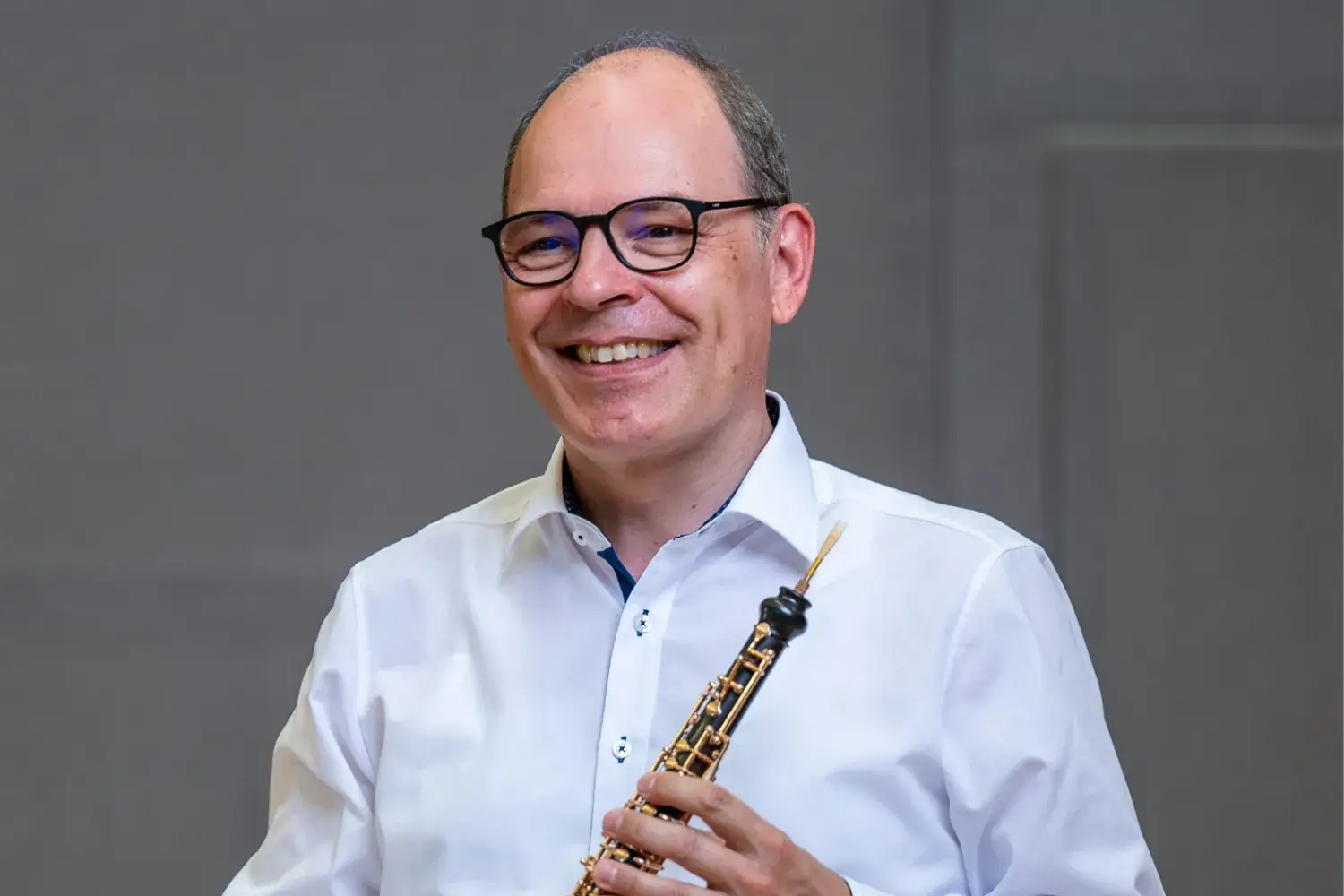
Ralf-Joern Koester is the principal oboist at the Nuremberg State Theater, a music college teacher, and the author of the textbook “Reliable Reeds”. In the Stretta Journal, he talks to us about his life as a professional musician and his daily routine. He shares with us a clever exercise for the correct tongue position that can benefit everyone who plays a wind instrument.
Masterclass Oboe Koester
Are you applying for an oboe study program (Bachelor / Master)?
Then this masterclass is just right for you! Up to ten participants will be prepared for their entrance exams and advised on their studies within five days, and they will learn more about reed making. The instructors include:
- Simone Preuin (English horn, oboe, reed making)
- Heejung Kim (repetition)
- Isa Terwiesche (workshop on breathing & sound)
More information:
Website: https://oboenrohr.com/
Ralf-Joern Koester was born in 1966 in Düsseldorf and grew up in a musical household. He discovered his interest in the oboe at the age of ten. Today, he is the principal oboist at the Nuremberg State Theater, a music college teacher, and the author of the textbook “Reliable Reeds”.
Dear Mr. Koester, how do you prepare for concerts and opera productions?
A guiding principle from Walter Samuel Bartussek, a renowned lecturer at the Music and Arts Private University of the City of Vienna, as well as a body awareness trainer and mime artist, has stuck with me. During a joint course, he formulated a principle that essentially encompasses what we artists consider our overarching "work motto" and that we live by daily to best describe the moment of a performance:
"Anyone who wants to perform a show must have an idea of it."
To let this idea and the bigger picture emerge within me, I place special emphasis on paying attention to details. Looking into the score is essential for me when preparing for symphony concerts, operas, or solo concerts. When working on chamber music, I rarely practice from just the solo part but, if possible, from a piano reduction or even from scores to recognize and understand my musical surroundings from the beginning. An overview of all parts allows me to integrate my own part into the overall sound. Music acts as an expressive language, and my oboe is the medium through which I communicate with the audience. This approach enables me to develop a vivid idea of how I want to interpret the musical story or create sound images.
What is your stance on daily practice?
Effective practice does not happen by chance. The brain and body are like an infinite storage, constantly being fed with information. But which information helps me to learn quickly and efficiently, and which should I avoid during practice? The "basics" are part of daily practice, and this is confirmed by every professional musician. Dexterity must be continuously trained, as must the coordination between fingers, tongue, and breathing.
Playing a musical instrument involves the whole body. Clean articulation, whether in a flowing legato or a precise staccato, is only possible through the perfect interplay of different parts of the body.
A powerful musculature is not given by nature but must be maintained through regular practice or rebuilt after a break, be it after a vacation or a break due to illness.
Related in Stretta Journal
The tongue is a crucial component for playing a wind instrument – how do you train the tongue?
Exactly, the start of a tone is significantly influenced by the tongue, even though it is not visible during playing. Therefore, it is important to understand what the tongue does inside the oral cavity. A simple comparison: If we bite our tongue, it was obviously in an inappropriate place, like between the teeth, causing pain. The correct position of the tongue while playing a wind instrument is just as crucial. This can be observed with a small camera at the corner of the mouth, but this is not practical for daily practice or weekly lessons.
The challenge is to understand the tongue’s position and movement during playing. Since the tongue is only noticeable when it contacts a tooth, lip, or object in the mouth (like the oboe reed), we must ensure that the tongue is in the right place and doesn’t move unnecessarily while playing. To check this, I use a small, round candy, such as a Tic Tac, placed on the tongue at the front.
While playing a long note, the candy should not fall off the front, right, or left. If it falls, it indicates unnecessary tongue movement. The position of the candy when it falls gives clues about the direction of the tongue's movement. For instance, if it falls forward, the tongue moved backward.
This exercise has shown me that the tongue twists sideways in some oboists, negatively affecting airflow and staccato. I've also observed that the path of the tongue lengthens during its backward movement from the reed if it arches, slowing down the staccato process. The arching causes the candy to fall off the front even with slow tongue movement.
This method cannot represent all nuances of tongue movements in the mouth, but it helps identify unfavorable or incorrect movements and often confirms suspicions already formed by listening impressions during lessons.
How does this tongue exercise affect short notes, e.g., in staccato?
Staccato is an articulation technique where the vibration of the oboe reed is briefly and evenly interrupted by the touch of the tongue. It is important to ensure that the sound and volume remain the same between the interrupted notes and the sustained notes. Therefore, one should first establish this equality: The sound of a sustained note should be identical to the sound of the repeatedly tongued notes divided into individual notes by the tongue.
It is advisable to always perform staccato exercises on single notes in conjunction with long tones and to practice staccato passages in legato to ensure that the sound, as well as the areas of airflow, breath support, and embouchure, remain unchanged. Hearing also plays an important role in this assessment, as the idea at the end of the practice process is crucial for making complex processes retrievable under the "roof" of the musical idea.
What is particularly important to you in your musical work?
A central concern for me is to make the style of the respective composer and era audible. How does a composer or musical style sound unmistakably? What should be taken into account to play "stylistically correct" and ensure that, for example, Bach does not sound like Brahms or Mozart does not sound like Bruckner? Explaining this in words is challenging. Nevertheless, I am delighted that the oboe is at home and used in every era of music history. We have the privilege of engaging with the entire range of eras and composers and immersing ourselves in the lives they left us through their music.