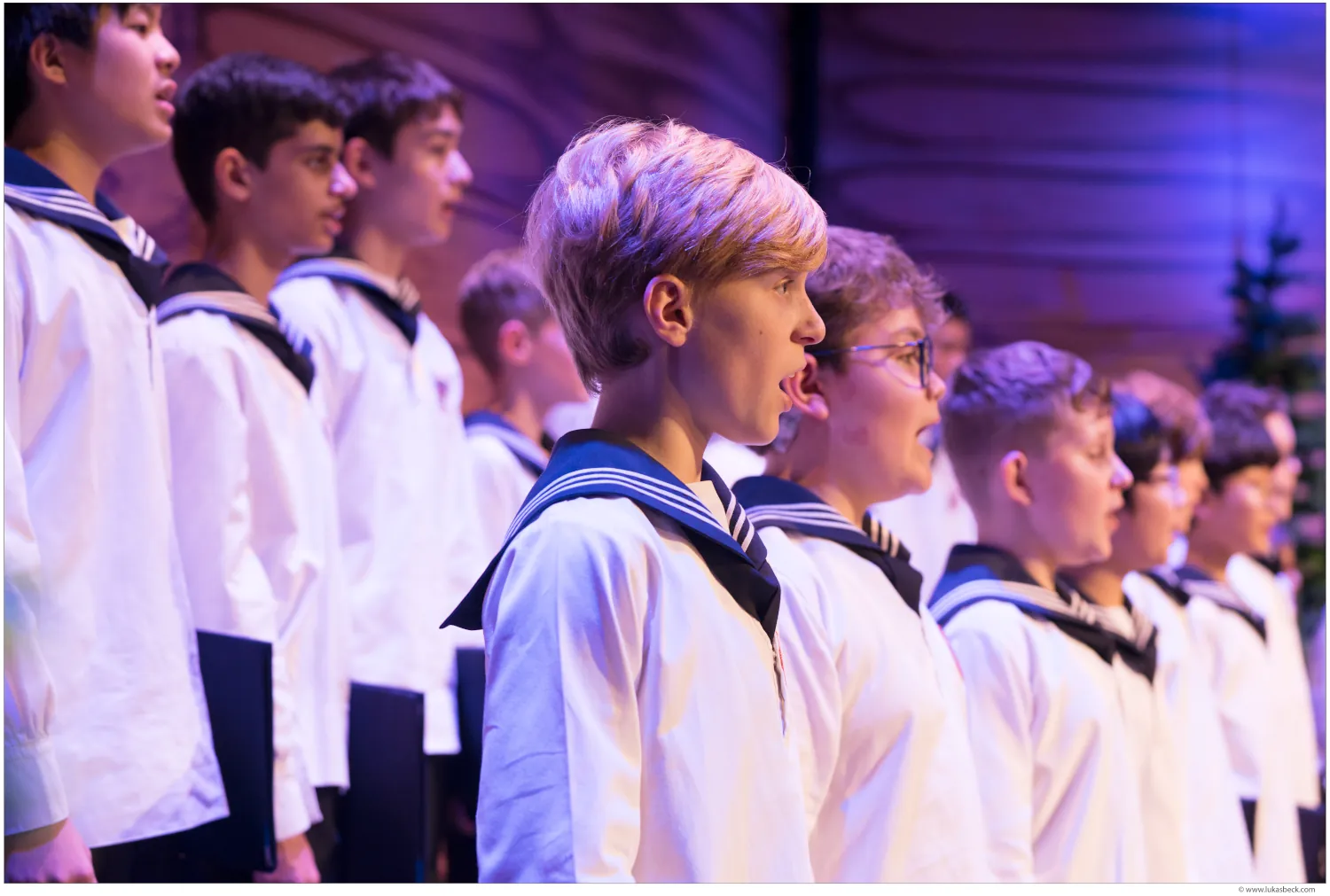
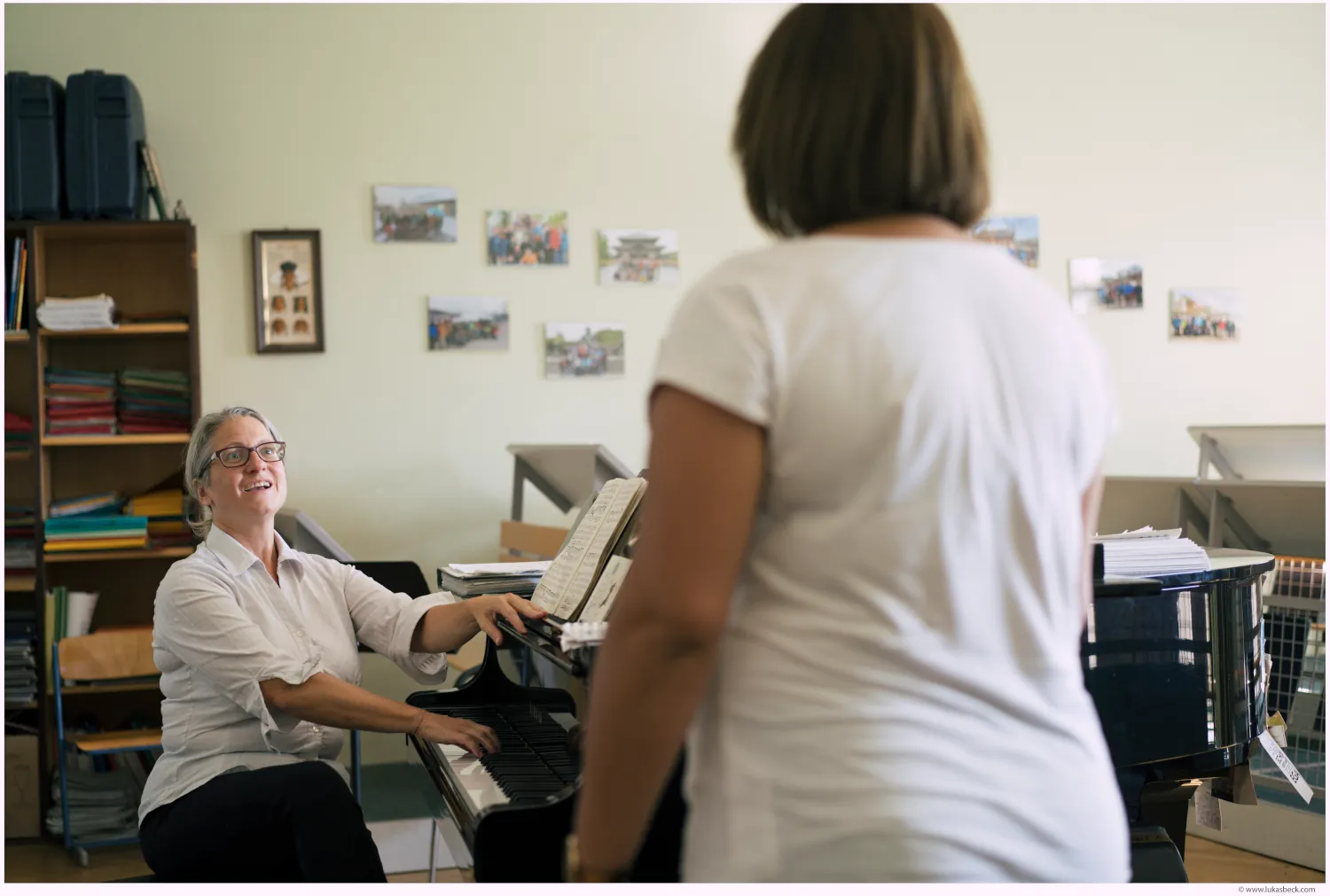
The Vienna Boys' Choir celebrates 525 years. Alice Rath-Stépán explains how she puts her heart and soul into nurturing young voices in the choirboys and choirgirls.
4/17/2025
CHORstimmen – No. 3
Vocal Training at the Vienna Boys' Choir
(02/27/2024)
In the 2nd district of Vienna lies the Palais Augarten: residence, school, and training center of the Vienna Boys' Choir - it's a whole campus attended by 330 children and adolescents aged 6 to 18. Not only boys come here to develop their musical talent, train their voices, and because they enjoy singing in choirs. The school, specially tailored to musical education, offers children a vocal development at the highest level with plenty of stage experience: Active Vienna Boys' Choir members travel the world on their tours.
This year, the Vienna Boys' Choir celebrates its 525th anniversary. In 1498, Emperor Maximilian I initiated the founding of a court chapel in Vienna, laying the foundation for the Vienna Boys' Choir.
Today, there are between 90 and 100 Vienna Boys' Choir members aged 9 to 14 who attend the first four classes of the Gymnasium (in Germany, equivalent to grades 5 to 8) in Augarten. They are divided into 4 concert choirs. Each choir has its own conductor and educational team. They live in the boarding school. Together, the choirs perform around 300 concerts per year. A special feature of the school: The school year is divided into three parts, or trimesters. The boys attend school for two trimesters and go on tour for one trimester.
For the 2024/25 school year, it is planned to integrate the Vienna Choir Girls, who have existed since 2004 as a chamber choir, into the school to provide them with more intensive musical training. They will then form a 5th concert choir and also go on their own tours. Initially, there is no boarding school for the choir girls for financial reasons, but it is desired for the future.
rowcol classes="col-xs-12 col-lg-8 circle"
Interview with Alice Rath-Stépán
In our 3rd edition of CHORstimmen, we meet Alice Rath-Stépán, an opera singer and vocal coach, who dedicates herself with great passion and commitment to the training of young voices at the Vienna Boys' Choir and the Vienna Choir Girls.
Alice Rath was born in Vienna, where she studied solo singing at the Conservatory of the City of Vienna with M. Zimmermann after graduating. She completed her education with studies in vocal pedagogy and attended the opera class of Lucia Meschwitz, as well as master classes with KS Wicus Slabbert, David Lutz, Charles Spencer, Kurt Widmer, and KS Brigitte Fassbänder.
Dear Alice, you have been teaching vocal training to the Vienna Boys' Choir and the Vienna Choir Girls since 2017. How did you come to the Vienna Boys' Choir?
A dear colleague who has been teaching at the Boys' Choir for a very long time told me that there were some vacant hours. I applied, was invited to an audition, and initially hired on a trial basis. After one school year, I was then hired permanently.
Can you tell us something about the application process at the WSK? What is the procedure for an audition? What is the ideal age for an audition at your school?
Boys and girls who like to sing and especially want to sing in a choir can apply to the Vienna Boys' Choir or the Vienna Choir Girls at any time. For this, you can use the following link: https://wsk.at/vorsingen.
An audition can be done live or virtually. Small vocal exercises are performed, rhythms clapped, tones repeated, and a song performed. In addition to musical talent, the joy of singing and the desire to be part of the choir are especially important. If all requirements are met, the child is invited for a trial period.
Can you describe a typical school day?
The Boys' Choir members exclusively reside in the boarding school. After a common breakfast, the first lessons take place from 7:30 to 10:50 a.m. in mathematics, German, and English. Rehearsals take place from 11 a.m. to 1 p.m. The choir rehearsals take place in their respective rehearsal rooms. Then they have a common lunch in the dining room followed by free time until 2:30 p.m. If special projects are planned, additional rehearsals or solo rehearsals are scheduled. From 2:30 to 5:50 p.m., they have another lesson; snacks are provided in the afternoon. Dinner is served from 6 to 7 p.m. After that, the day is often concluded with extracurricular activities.
How much music instruction is there besides singing?
How many music lessons are there in addition to singing?
In addition to singing, there are two lessons per week in which music theory and ear training are taught. In the upper level, harmony and performance practice are added. The curriculum was designed in collaboration with the Mozarteum in Salzburg and the University of Music in Vienna and is considered an ideal preparation for studying music.
What is the concert activity of the Vienna Boys' Choir and Vienna Choir Girls like? Are there joint performances?
The Vienna Boys' Choir sings the Sunday masses in the Vienna Hofburg Chapel – this is the core repertoire; usually, they are masses from the Viennese Classical period and Romantic period, including works by Haydn, Mozart, Beethoven, Schubert, and Bruckner. In Advent and Lent, predominantly Renaissance and Baroque masses are performed, often by court chapel masters such as Antonio Caldara or Johann Josef Fux. They also perform the programs that have made them world-famous – a cross-section of their very broad repertoire, ranging from motets from all periods to pop or film music. The programs are dedicated to a specific theme, such as "A Night at the Theater," "The Four Seasons," or "525," fitting for the anniversary. The exact repertoire is chosen by the respective conductor in consultation with the artistic direction, taking into account the preferences and vocal characteristics of the boys.
External content from YouTube
We need your consent to display this content because personal data is transferred to the platform operator (partly to the USA). You can revoke your consent at any time. You can find more information here: Privacy Policy.
The Vienna Choir Girls sing their own programs, which are structured similarly to those of the boys; their concerts are also dedicated to themes, such as "Good Vibrations." Just like with the boys, the conductor determines the repertoire in consultation with the artistic direction; just like with the boys, the preferences and vocal characteristics of the singers are taken into account – the girls are often in the midst of voice changes at this time. The choirs are frequently requested for special tasks; for example, the boys sing in Gustav Mahler's Symphony No. 3 or Benjamin Britten's War Requiem. The choir girls participated in the Mauthausen Oratorio by Joe Zawinul and in rwh 4 by Mark Andre, and they were involved in Wien Modern.
External content from YouTube
We need your consent to display this content because personal data is transferred to the platform operator (partly to the USA). You can revoke your consent at any time. You can find more information here: Privacy Policy.
Yes, there are opportunities for joint performances: such as at the New Year's concert of the Vienna Philharmonic in 2023 under Franz Welser-Möst; at the reopening of the Austrian Parliament in January 2023; at our "525 Years" anniversary concert at the Vienna Musikverein, or now at Christmas in Vienna.
What do the Vienna Boys' Choir do in their free time? Besides music, are there other hobbies they pursue?
Of course! Many of our boys are very athletic; they spend every free moment on the sports fields in the park, playing soccer or basketball. There are table tennis tables where they enjoy playing "Ringerl" (round robin). Additionally, the school has its own swimming pool. In the boarding school, there are also plenty of board games and a small library. At certain times, they also play video games. Some children also play an instrument intensively. For example, the pianist Lukas Sternath was once a choirboy. He divided his free time between practicing the piano and playing soccer.
On weekends, most children go home to their families. The boys who stay in the boarding school – we have children from other states or even from abroad – go on outings with the caregivers. They go hiking, barbecue sausages, go to the movies, visit the zoo, or go bowling.
External content from YouTube
We need your consent to display this content because personal data is transferred to the platform operator (partly to the USA). You can revoke your consent at any time. You can find more information here: Privacy Policy.
What happens when the time at the Vienna Boys' Choir is over? Do they have a way to continue?
Since 2010, there has been an upper level with classes 5 to 8 (in Germany, equivalent to classes 9 to 12) for boys and girls with a focus on vocal music. For this, the University of Music in Vienna and the Mozarteum in Salzburg have developed a special curriculum for individual promotion of young voices. It's even possible to obtain the Abitur (high school diploma) with a focus on voice training or singing at the Vienna Boys' Choir.
How many graduates of the school pursue a career as professional musicians?
Approximately one-third of the students remain committed to music in a professional capacity, and this trend is increasing.
How often do the children have lessons with you, and what does a voice training session with you entail?
The boys typically have individual voice training with me two to three times a week. During these sessions, we work on posture, breathing, vocal placement, tone quality, vowel balance, pronunciation, vocal range, etc. I always start with some vocal exercises. Depending on the children's concentration and needs, we then focus on one or more aspects or work on literature that the boys bring with them, such as if they need to sing a solo or if there are technical issues at a particular part.
Children's attention spans are usually shorter than those of adults, so I keep the sessions shorter, averaging about 20 minutes, and prefer to have them more frequently. I use a lot of imagery and activities from their daily lives and try to find a playful approach to technical exercises.
Unfortunately, I only see the girls once a week for 20 minutes in pairs. This is very little, but it will certainly increase next year. Nevertheless, even with the few sessions each week, progress is noticeable from week to week.
External content from YouTube
We need your consent to display this content because personal data is transferred to the platform operator (partly to the USA). You can revoke your consent at any time. You can find more information here: Privacy Policy.
In your opinion, what is the most important foundation for voice training with children? What exercise do the children enjoy the most?
I like to combine breathing and vocal exercises because, in my opinion, the interaction between breathing, support, and vocal production must be practiced primarily. Therefore, I often do an exercise descending by a fifth, always supporting over a third. I work a lot starting from the vowel and with vowel balance, generally using exercises from a higher pitch downward with younger voices, so they can start well in the head voice. Most boys and girls enjoy a kind of triad staccato exercise; they are particularly focused during that.
If there are ever physiological vocal problems, how do you deal with them?
If a boy experiences hoarseness and vocal problems for an extended period, not due to a common cold, we consult an ENT specialist. If speech therapy is prescribed, the boy can receive it directly from our speech therapist.
What happens when the boys are in voice change? Do they have to take a break then?
No, they stay in their choirs and continue with individual voice training. There are days or weeks when their voices just don't cooperate, often in combination with a minor illness, so they might not sing in rehearsals or skip the notes that they can't produce.
You are also a professional opera singer yourself. Are there experiences from this profession that influence your teaching?
Yes, definitely. I bring my experiences from my solo and choral work into the lessons, especially in the direct preparation before performances, such as warm-ups or preparing solo parts with the boys.
What do you enjoy most about working with the Vienna Boys' Choir and Vienna Choir Girls?
The special thing about working with the Boys' Choir and Choir Girls is that it's never routine. There are always different demands; sometimes one comes in at the last minute to rehearse a mass solo, then someone has to quickly learn one of the three boys' roles in "The Magic Flute" to be able to step in at the opera. Sometimes we tackle a technical problem, sometimes they urgently need to tell me what they're annoyed about in their daily school life.
I also enjoy accompanying the boys over several years as their voice trainer (I haven't been teaching the girls for as long) and seeing how they develop both personally and vocally, and to be part of that development with them, sometimes even into young adulthood when they move on to the upper level.
Dear Alice, we thank you very much for this fascinating insight into your work with the Vienna Boys' Choir!
For a deeper insight into the history of the Vienna Boys' Choir, their everyday life and tours, experiences, and dreams, we recommend the recently released book "Ein Chor erobert die Welt" by Tina Breckwoldt, published for the anniversary!
Your specialist for all kinds of sheet music. Online shop, sheet music, music scores and play along for download, books, music stands, music stand lights, accessories.